 Patterns
How to sew a puff sleeve: gathered cap and elastic hem
How to sew a puff sleeve: gather the cap with basting, set it into the armhole, then finish the hem with an elastic casing, a band or a ruched seam.
A note on measurements: this guide is written for US sewists, so it uses US units first: inches, yards and US paper sizes (Letter, 36 × 48 in). Metric equivalents are in brackets where they matter. If you're not used to US measurements, convert them before you cut: 1 in = 2.54 cm, 1 yd = 91.4 cm.
Fabric grain in sewing is the direction the threads run in a woven fabric. The lengthwise grain runs parallel to the selvage and barely stretches, the crosswise grain runs from selvage to selvage and gives a little, and the bias runs diagonally and stretches the most. Lining up each pattern piece with the right grain is what makes a garment hang straight, so this guide shows how to find each grain, test whether your fabric is off grain, straighten it, and lay out your pattern pieces accurately.
A woven fabric is made of two sets of threads. The warp threads are stretched on the loom first and run the length of the fabric. The weft threads are woven over and under them from side to side. Where the weft turns at each edge it forms the selvage, the firm, finished edge that doesn’t fray.
The lengthwise grain follows the warp threads, parallel to the selvage. It is the strongest and most stable direction, with almost no stretch, so most pattern pieces are cut with their length on it. When a pattern says “straight grain” or shows a plain grainline arrow, this is the grain it means.
The crosswise grain follows the weft threads, at a right angle to the selvage. It stretches a little more than the lengthwise grain. Patterns occasionally place wide pieces or border prints on it.
The bias is any diagonal line across the fabric. The true bias sits at 45 degrees to both grains and has the most stretch and the softest drape of any direction. Bias strips are cut on it so they curve smoothly around a neckline, and bias-cut skirts use it to skim the body. The trade-off is that bias edges stretch easily as you handle and sew them.
Check the grain before cutting, especially on a remnant with no selvage.
Fabric is off grain when the crosswise threads no longer sit at a right angle to the lengthwise threads. It can arrive like that from the bolt, and washing can shift it further.
A small amount of distortion won’t show in most garments. A large one makes seams twist and hems dip after washing.
Straighten fabric after prewashing, because washing can shift the grain again.
Don’t overdo the pull. Heavy tugging can distort the weave or a print, and some fabrics can’t be straightened at all. Many synthetics, blends and fabrics with a resin, wrinkle-resistant or other heat-set finish are set off grain at the mill and spring back however much you pull. With these, cut with the pattern on the true grain where you can see it, or follow the print if the print is the more visible line.
On a print, the design sits on top of the weave, so it can be printed slightly crooked even when the threads are straight. On a small all-over print, follow the grain. On stripes, checks, plaids and border prints, the eye reads the printed line first. If the print is visibly crooked, follow the print and staystitch the cut edges to stop them stretching, or choose a different fabric for a garment where both need to be straight.
Every pattern piece has a grainline arrow. It doesn’t matter where the arrow sits on the piece: what matters is that it runs parallel to the selvage.
If the arrow is short, extend it along the full length of the piece with a ruler before you start. When you copy a pattern onto pattern paper, trace the arrow at full length too. On a PDF pattern, check the test square first: the guide to printing PDF sewing patterns covers this. Cut woven interfacing on the same grain as the piece it supports.
A bias piece has its grainline arrow drawn at 45 degrees to the piece’s center line. Lay it exactly as above, measuring both ends of the arrow to the selvage. Bias pieces are best cut single layer, because the fabric shifts as you cut through two layers. Hang a bias-cut garment for 24 hours before hemming, since the hem drops unevenly as the bias relaxes.
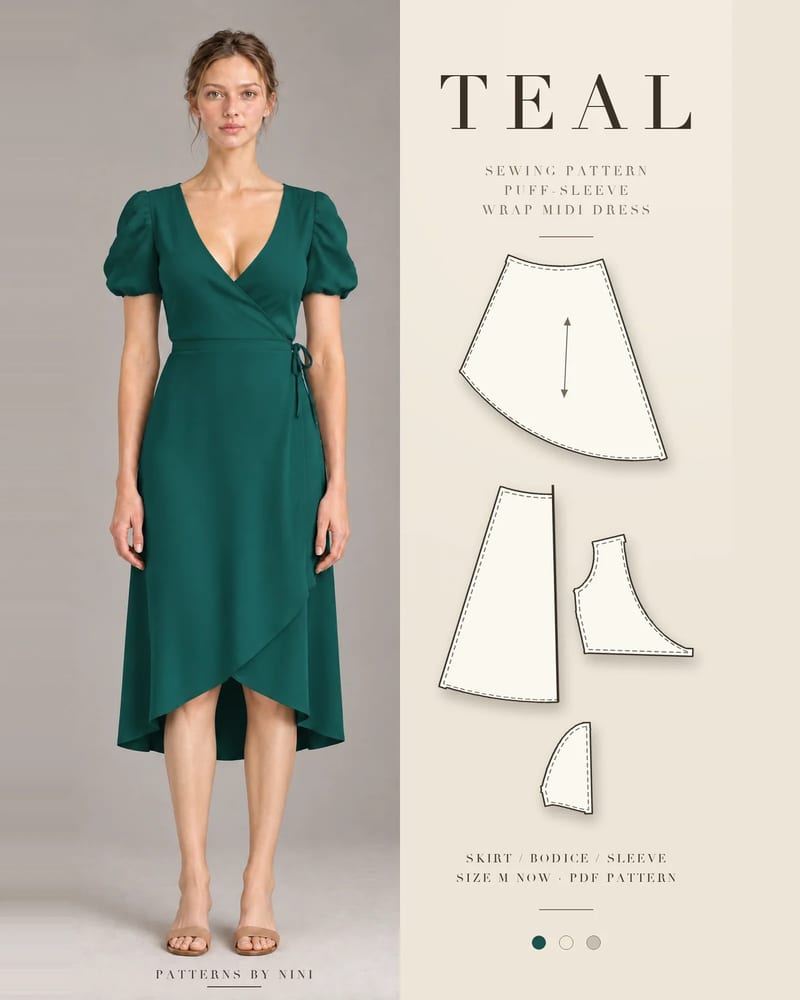
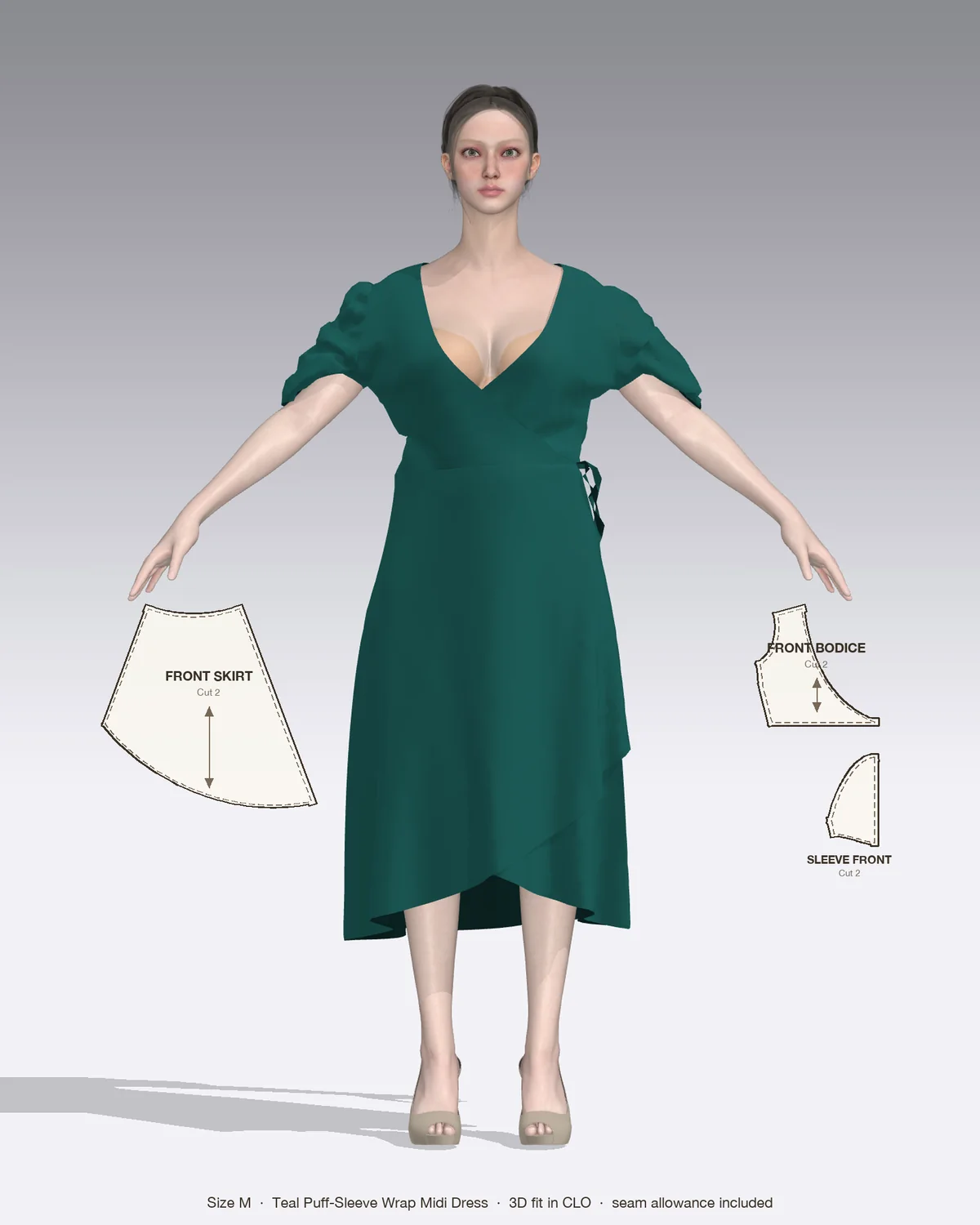
The Teal puff-sleeve wrap midi dress is a good project for putting grain into practice. Its recommended fabrics are drapey wovens such as crepe, rayon challis and viscose, which shift off grain easily on the cutting table, so fold carefully, check that the fold lies flat and measure both ends of every grainline arrow. Teal’s neckline and wrap edges are finished with a bias facing, made from 1 in bias strips cut at 45 degrees, which is what lets the facing turn smoothly around the deep V. The guide to sewing a facing shows how to understitch and press a facing so it stays inside.
Other patterns use the bias in different ways. The Ada wrap maxi dress finishes its V neckline with a bias facing, and the Sade slip midi dress has a bias-cut skirt that skims the body and flares at the hem, where careful grain placement decides how evenly it hangs.
| Problem | Likely cause | Fix |
|---|---|---|
| Side seams twist toward the front | Pieces cut off grain, or fabric not straightened | Recut if possible; next time measure both ends of the arrow to the selvage |
| Pant legs spiral around the leg | Front and back legs cut off grain | Check the grainline on both legs before cutting; recut the worst leg |
| Hem dips on one side after washing | Fabric was off grain and relaxed in the wash | Prewash, straighten, then cut; rehem after the garment has been washed |
| Bias edges stretched and wavy | Bias edge handled or pulled while sewing | Staystitch bias edges straight after cutting; let the feed dogs move the fabric |
| Stripes look crooked | Print followed the grain while the print was off | Follow the print on stripes and checks, and staystitch the edges |
| Fabric won’t straighten | Heat-set finish or synthetic fibers | Don’t keep pulling; follow the visible line and cut single layer |
How to sew a puff sleeve: gather the cap with basting, set it into the armhole, then finish the hem with an elastic casing, a band or a ruched seam.
What is interfacing in sewing? The hidden layer that firms facings, collars and zipper openings. Learn the types, how to pick a weight and how to fuse it well.
May we use Pinterest cookies to measure visits and purchases and improve our advertising? You can shop either way and change your choice in Cookie settings. Privacy policy