A note on measurements: this guide is written for US sewists, so it uses US units first: inches, yards
and US paper sizes (Letter, 36 × 48 in). Metric equivalents are in brackets where they matter. If you're not used to US
measurements, convert them before you cut: 1 in = 2.54 cm, 1 yd = 91.4 cm.
To hem jeans, pin the length while you wear your usual shoes, mark a line 1 1/8 in (2.8 cm) below the new hemline and cut. Press the edge up in a double fold, then topstitch it from the right side with a denim needle and a long stitch, slowing down over the thick side seams. That is how to hem jeans so they look like the factory hem, on any home sewing machine.
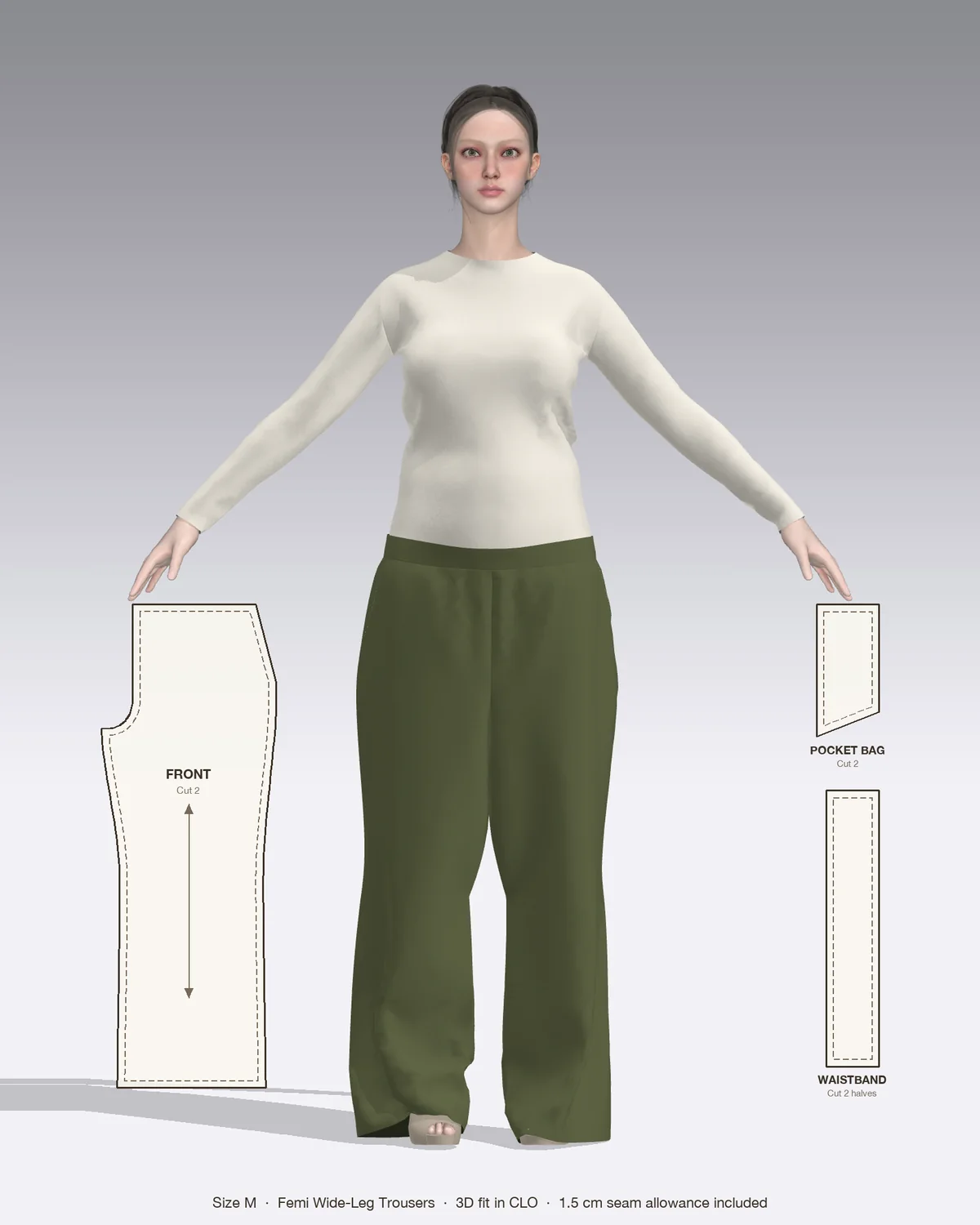
Draped in CLO 3D: the Femi with its pattern pieces, drawn to scale.
The same steps work for jeans you are making and for store-bought jeans that are too long. If you want to keep the original, faded factory hem instead, that is a different method, covered briefly near the end.
What you need
Tape measure, hem gauge or ruler and tailor’s chalk or a marking pen.
Pins or sewing clips. Clips grip thick denim better than pins.
Sharp fabric shears that can cut through two layers of denim.
Iron on the cotton setting with steam.
Jeans (denim) needle: 90/14 for light and medium denim, 100/16 or 110/18 for heavy denim.
Thread: topstitching or jeans thread in gold or blue for the needle, all-purpose polyester in the bobbin. Or all-purpose thread for both if you plan to use a triple stitch.
A hammer or mallet and a hump jumper (optional) for the side seams.
Mark and cut the new length
Wash the jeans first if they are new or the fabric is new. Cotton denim can shrink, and you want to hem them at their washed length.
Put the jeans on with your usual shoes. Sneakers and heeled boots need very different lengths.
Fold the hem up to the length you want and pin it. For a straight or bootcut leg, a common target is the back of the hem just clear of the floor. Pin each leg separately, because one leg is often a little longer.
Take the jeans off, turn them wrong side out and lay each leg flat with the inseam and outseam matched. Measure from the old hem up to the pins on both seams so the line is level.
Chalk the new hemline straight across the leg. This is where the bottom fold will be.
Draw a cutting line 1 1/8 in (2.8 cm) below the hemline, all the way around, and cut. For a slightly deeper hem, cut 1 1/4 in (3 cm) below instead.
Press the double fold
A double-fold hem hides the raw edge completely, so there is no need to finish it first.
Press the hemline fold up along the chalk line. Hold the iron still for a few seconds with steam to set the crease, then lift and move it rather than sliding it, which can stretch the denim.
Unfold, then turn the raw edge up to meet the crease, leaving a scant 1/8 in (3 mm) gap below it. Press. The gap lets the second fold lie flat instead of buckling.
Fold again on the hemline crease and press. You now have a hem about 1/2 in (1.3 cm) deep with the raw edge tucked inside.
Hammer the side seams. Where the inseam and outseam pass through the hem, there can be six or more layers of denim. Lay that spot on a hard surface, cover it with a scrap of fabric and tap it flat with a hammer. A little steam first makes this easier.
Clip the hem in place. Clips are easier to remove as you sew than pins.
How to hem jeans by machine
Set up the machine
Fit a new jeans needle in the size for your denim.
Thread the top with topstitching thread and the bobbin with all-purpose thread in a matching color. If the machine struggles with thick thread, use all-purpose thread on top and a triple straight stitch instead.
Set a stitch length of 3 to 3.5 mm. Short stitches look weak on denim and can chew the fabric.
Take off the extension table so the leg slides over the free arm.
Test on two layers of an offcut, folded the same way as the hem, and adjust the top tension until the stitches lie flat on both sides.
Topstitch the hem
Start at the inseam, right side out, with the hem facing up. The backstitches at the start and end will hide there.
Sew about 3/8 in (1 cm) from the bottom edge, which is just below the top of the folded hem inside. Use a seam guide line on the needle plate or a strip of tape as a guide.
Slow down before each side seam. Stop with the needle down, raise the foot and slip a hump jumper under the back of the foot so it sits level as it climbs the seam. Turn the handwheel by hand for the stitches over the thickest part, then move the jumper to the front of the foot as you come down the other side.
Keep the line straight by watching the edge of the hem against the guide, not the needle.
Overlap the first stitches by about 1/2 in (1.3 cm) at the inseam, then backstitch or pull the threads to the inside and tie them off.
Press the finished hem from the right side with a pressing cloth to set the stitches.
The flat felled seam guide uses the same jeans-style topstitching on long seams.
Hem jeans by hand or without sewing
By hand. Press and hammer the hem as above. Thread a needle with doubled polyester or topstitching thread about 20 in (50 cm) long. Working from the right side, sew a backstitch about 3/8 in (1 cm) from the edge, through all layers, with stitches about 1/8 in (3 mm) long. Use a thimble to push through the side seams. On the outside a backstitch looks like a machine line. The hand sewing stitches guide shows the backstitch step by step.
Without sewing. Iron-on hemming tape works as a short-term fix: cut 1 in (2.5 cm) below the hemline, fold up, slip 1/2 to 3/4 in (1.3 to 2 cm) fusible tape into the fold and press following the tape’s instructions. Repeated washing can loosen it, so stitch it later if you can.
Keeping the original hem. To keep the faded factory hem, the old hem is folded up and stitched just above it with a zipper foot, then the excess is trimmed and the seam is hidden inside. It works best on straight legs and is a separate technique from a new double-fold hem: see how to hem jeans with the original hem for the full steps.
Flared, wide-leg and stretch jeans
Flared and bootcut jeans get wider toward the hem, so a turned-up allowance is narrower than the leg and pulls. Keep the hem narrow, or cut 1/4 in (6 mm) below the hemline, sew seam tape or a bias facing to the edge and turn that up instead.
Wide-leg jeans are the easiest: the allowance matches the leg and a standard double fold lies flat.
Stretch jeans with elastane can wave when topstitched. Lengthen the stitch to 3.5 mm, reduce the presser foot pressure if your machine allows it, and don’t pull the fabric as you sew.
Patterns by Nini pants with a topstitched hem
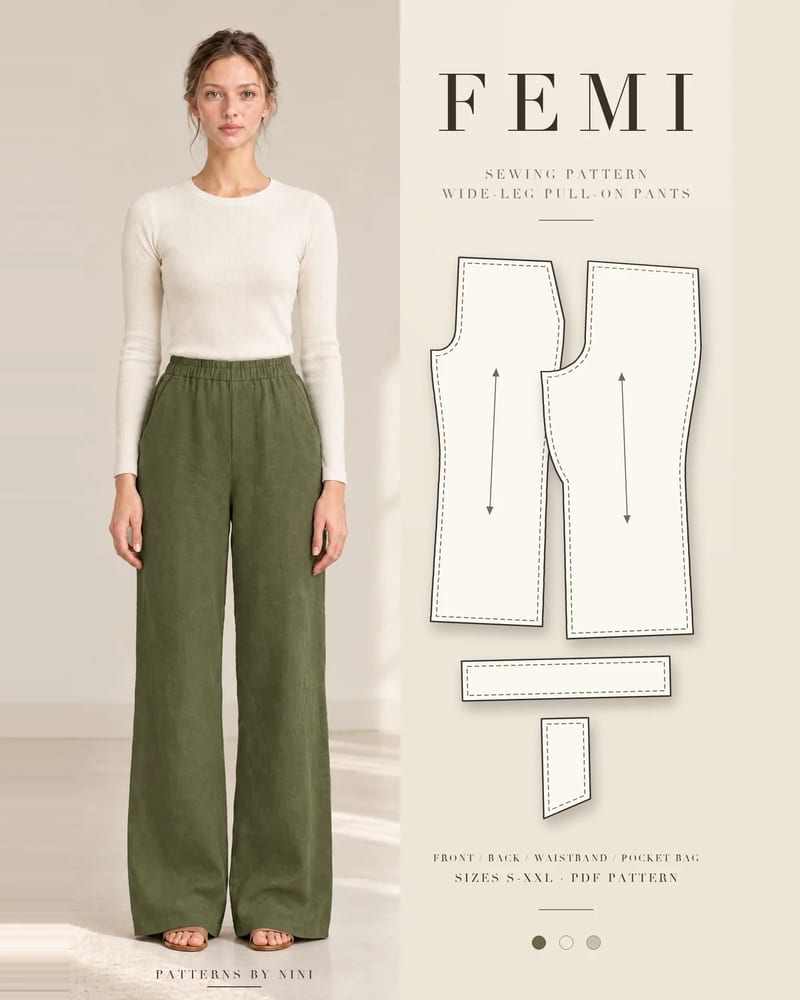
The Femi wide-leg pants aren’t jeans, but their straight wide legs are the same width from knee to hem, so the double-fold hem and topstitch above suit them well. Femi is made in linen, linen-viscose, cotton or Tencel, so swap the denim needle for a universal 80/12, use all-purpose thread and a 3 mm stitch, and press at the setting for your fabric. Mark the length wearing your usual shoes, because the hem is drafted to just cover the top of the foot.
The Tayo flare pants flare from the knee, so follow the flared-leg advice above and keep that hem shallow. For tailored styles such as the Tolu pleated pants, a blind hem looks better than topstitching; the guide on how to hem pants covers that method.
Common mistakes and how to fix them
Problem
Likely cause
Fix
Needle breaks at the side seam
Wrong needle or sewing too fast over the bulk
Fit a 100/16 jeans needle, hammer the seam, turn the handwheel by hand
Stitches bunch or skip at the seams
Presser foot tilting as it climbs
Use a hump jumper under the low side of the foot
Hem twists to one side
Leg not laid flat with seams matched when marking
Re-mark with inseam over outseam
Second fold ripples
Raw edge folded right up to the crease
Leave a scant 1/8 in (3 mm) gap in the first turn
Topstitching looks loopy underneath
Top tension too low for thick thread
Raise the top tension slightly and test on an offcut
Jeans too short after washing
Hemmed before washing
Wash and dry new denim before marking the length
One leg longer
Both legs marked from one pin
Pin and mark each leg on the body
Once both legs are done, try the jeans on again with the same shoes and check that the back of the hem sits where you pinned it.
Frequently asked questions
How much should I cut off when hemming jeans?
Mark the finished length first, then cut 1 1/8 in (2.8 cm) below that line for a narrow double-fold hem like most store-bought jeans. That allowance turns up about 5/8 in (1.6 cm) and then 1/2 in (1.3 cm). If you want a deeper hem, cut 1 1/4 in (3 cm) below and turn 1/2 in, then 3/4 in.
What needle and thread do you use to hem jeans?
Use a jeans or denim needle, size 90/14 for light and medium denim or 100/16 to 110/18 for heavy denim. For the classic look, thread the top with heavier topstitching or jeans thread in gold or blue and put all-purpose thread in the bobbin. All-purpose thread with a triple straight stitch also gives a bold line.
How do I sew over the thick seams on jeans?
Flatten the seam inside the hem with a hammer, then slow down as you reach it and turn the handwheel by hand for the last few stitches. A hump jumper (sold as a Jean-a-ma-jig or seam jumper) slipped under the back of the presser foot keeps it level so the stitches don't bunch or skip.
Can you hem jeans by hand?
Yes. Press the double fold as for a machine hem, then sew it with a backstitch close to the top fold, using a strong doubled thread and a thimble. A backstitch looks like a machine stitch on the outside. It takes longer, especially at the side seams, but it is durable and needs only a needle and an iron.
How to sew a French seam: stitch wrong sides together, trim, fold and stitch again to enclose the raw edges. Measurements for every common seam allowance.
How to sew pants from a pattern: choose fabric and size, cut, sew pockets, leg seams and the crotch, then add an elastic waistband and hem. For beginners.
How to finish seams without a serger: zigzag, overcast, pinked, turned and stitched, French, flat-felled, bound and hand overcast, with settings for each.
Help us understand what inspires you
May we use Pinterest cookies to measure visits and purchases and improve our advertising? You can shop either way and change your choice in Cookie settings. Privacy policy
 Patterns