 Patterns
Seam gauge for sewing: what it is and how to use it
A seam gauge for sewing is a 6 in ruler with a sliding marker. Learn to use it for even hems, seam allowances, buttonholes, pleats, darts and elastic casings.
A note on measurements: this guide is written for US sewists, so it uses US units first: inches, yards and US paper sizes (Letter, 36 × 48 in). Metric equivalents are in brackets where they matter. If you're not used to US measurements, convert them before you cut: 1 in = 2.54 cm, 1 yd = 91.4 cm.
To sew a T-shirt, cut the front, back, sleeves and neckband from a stretch knit, then sew them in this order: shoulders, neckband, sleeves (set in flat), one continuous seam from sleeve hem to body hem on each side, and finally the hems. Use a ballpoint needle and a stitch that stretches, such as a narrow zigzag, and you can do it all on a regular sewing machine. That order is how to sew T-shirts quickly and neatly, because almost every seam is sewn while the pieces still lie flat.
This guide follows that order step by step, with stitch settings, the neckband method that gets a flat neckline, and fixes for the problems knits usually cause.
Fold the fabric along the crosswise direction, mark 4 in (10 cm) and stretch that section gently across the width until it resists. If it reaches 5.2 in (13.2 cm), it has 30% stretch; 6 in (15 cm) is 50%. Then let go: a good T-shirt knit springs straight back. If the stretch is less than the pattern asks for, the tee will fit tighter and the neckband may not go over your head.
Prewash and dry the fabric the way you will wash the finished tee. Cotton jersey often shrinks in length.
A rotary cutter and mat stop jersey from shifting as you cut.
Set a narrow zigzag about 1 to 1.5 mm wide and 2.5 to 3 mm long, or use the lightning-bolt stretch stitch. Use a 3/8 in (1 cm) seam allowance unless your pattern says otherwise. Test on a double layer of scrap first.
Shoulders are where a knit top stretches out first, so the tape is worth the extra minute.
Some patterns attach the band flat, before the second shoulder seam is sewn. The quarter-pinning works the same way; you just close the last shoulder and band end in one seam afterward.
Knits ease in without basting. For more on this flat method and when to set a sleeve in the round instead, see how to sew sleeves.
Try the tee on now, before hemming. This is the time to take in the sides or shorten the length.
Fold up the hem allowance, usually 3/4 to 1 in (2 to 2.5 cm), and press without dragging the iron. A strip of fusible knit interfacing or fusible web in the fold keeps it flat. Stitch from the right side with a twin needle or a narrow zigzag. The full method, including coverstitch and hand-sewn options, is in how to hem a T-shirt.
| Problem | Likely cause | Fix |
|---|---|---|
| Wavy or rippled seams | Fabric stretched as it fed | Lengthen the stitch, lower presser foot pressure, use a walking foot, steam press |
| Neckband stands away from the neck | Band too long | Unpick and shorten the band by 3/4 to 1 in (2 to 2.5 cm) |
| Neckline puckers or pulls | Band too short, or stretched unevenly | Lengthen the band slightly; re-pin at the quarter marks |
| Skipped stitches | Wrong or blunt needle | Fit a new ballpoint or stretch needle |
| Stitches snap when you pull the tee on | Straight stitch with no stretch | Resew with a narrow zigzag or stretch stitch |
| Fabric gets pushed into the needle plate | Seam started right at the edge | Start 3/8 in (1 cm) in, or hold the thread tails as you begin |
If a seam is only slightly wavy, hold a steam iron just above it and pat it flat. Many cotton jerseys shrink back into shape.
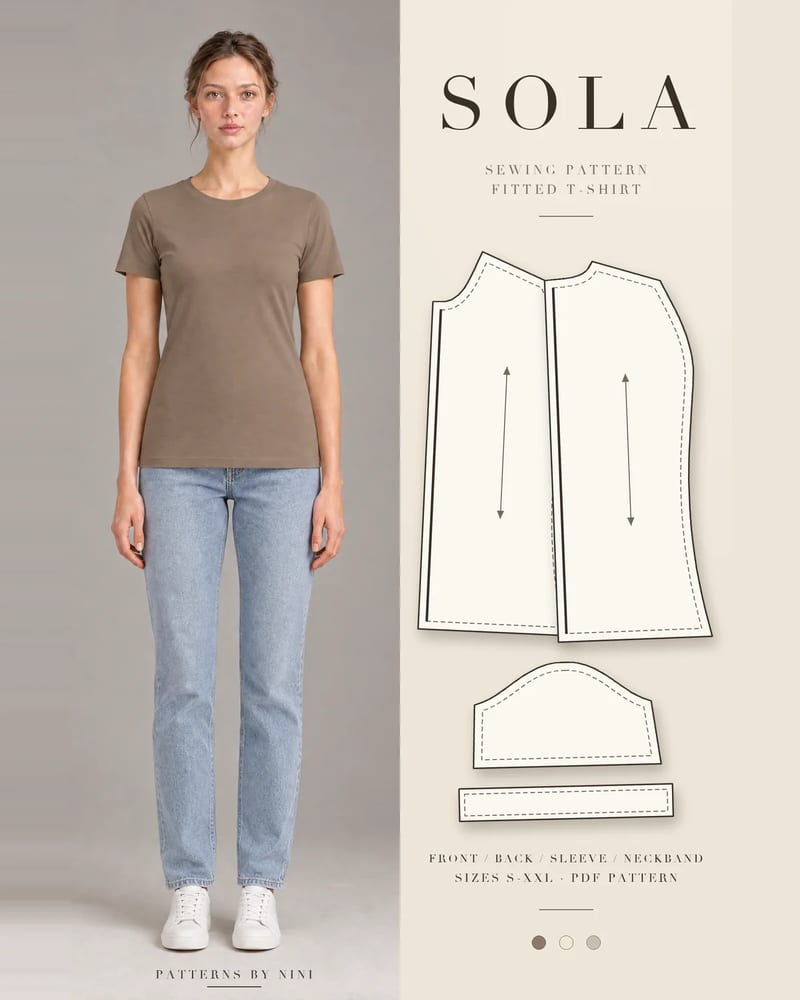
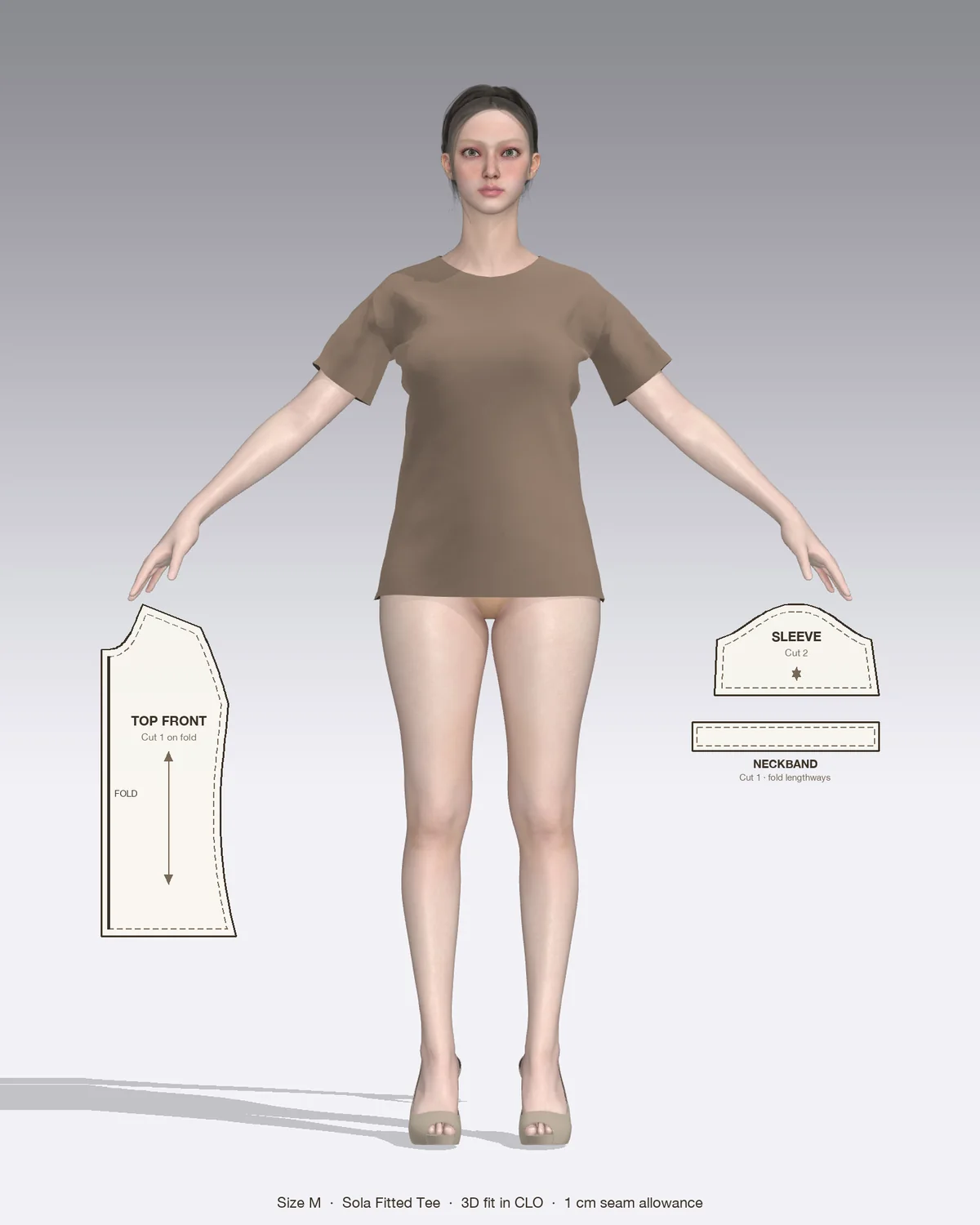
The Sola fitted tee is a good tee to practice these steps on. It is a classic short-sleeve crew-neck tee in six steps, sewn flat, with a sew-in neckband and short set-in sleeves that are set in flat. It has 2 in (5 cm) of ease at the bust, so it sits close without clinging, and a hip-length hem about 25 in (64 cm) at the back in size M. It comes in sizes S to XXL, rated beginner for knits, for cotton or viscose jersey with at least 30% widthwise stretch.
For a looser fit, the Wura oversized tee has dropped shoulders and a boxy body. The Tade boat-neck tee swaps the crew neck for a wide, shallow boat neckline with a narrow band, and the Lola rib top is a long-sleeve version in rib knit with a high crew rib neckband. Once you can sew a tee, the Dupe T-shirt midi dress uses the same neckband and set-in sleeves on a pull-on dress with side slits.
If this is one of your first projects, the guide to sewing patterns for beginners covers what to make next.
A seam gauge for sewing is a 6 in ruler with a sliding marker. Learn to use it for even hems, seam allowances, buttonholes, pleats, darts and elastic casings.
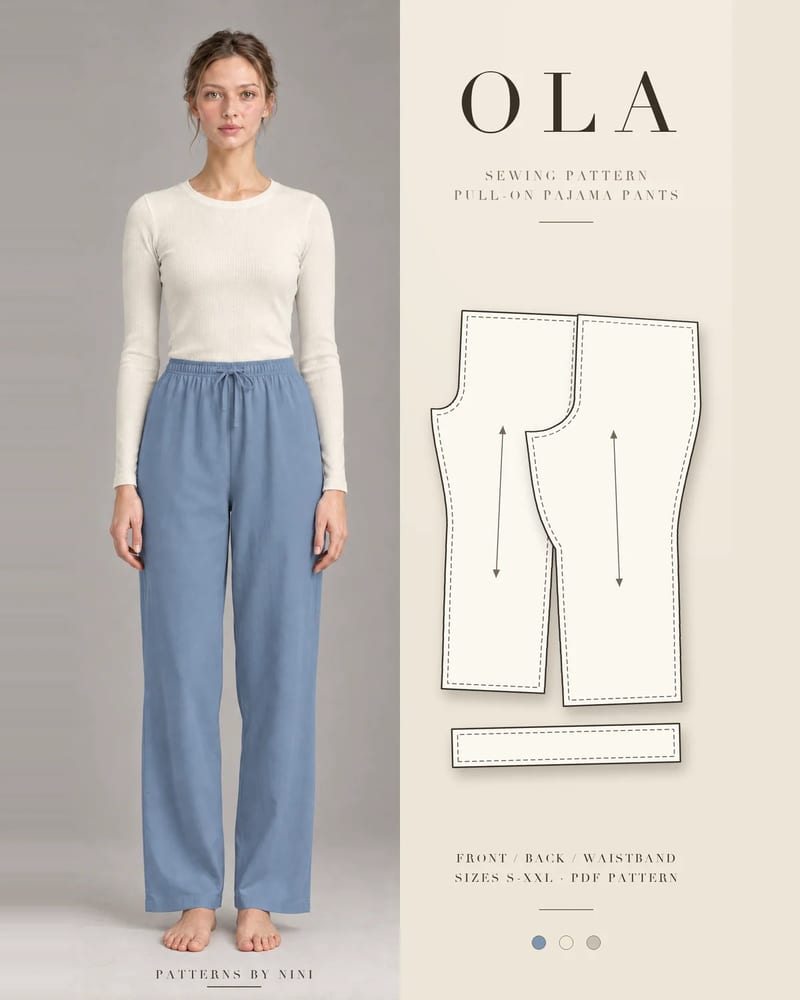
How to sew pajama pants step by step: pick and prewash fabric, cut, sew the legs and crotch, add an elastic and drawstring waistband, then hem.
How to use a magnetic sewing seam guide: set it to any seam allowance, sew straight seams and curves, and keep it clear of a computerized machine's electronics.
May we use Pinterest cookies to measure visits and purchases and improve our advertising? You can shop either way and change your choice in Cookie settings. Privacy policy