A note on measurements: this guide is written for US sewists, so it uses US units first: inches, yards
and US paper sizes (Letter, 36 × 48 in). Metric equivalents are in brackets where they matter. If you're not used to US
measurements, convert them before you cut: 1 in = 2.54 cm, 1 yd = 91.4 cm.
To sew a skirt, you cut a front and back (or two rectangles), sew the side seams, gather or shape the top edge to fit your waist, attach a waistband with a zipper or elastic, and hem. That’s the whole garment. This guide shows how to sew a skirt step by step using the most useful beginner version: a full gathered skirt on an interfaced waistband, closed with an invisible zipper in the left side seam.
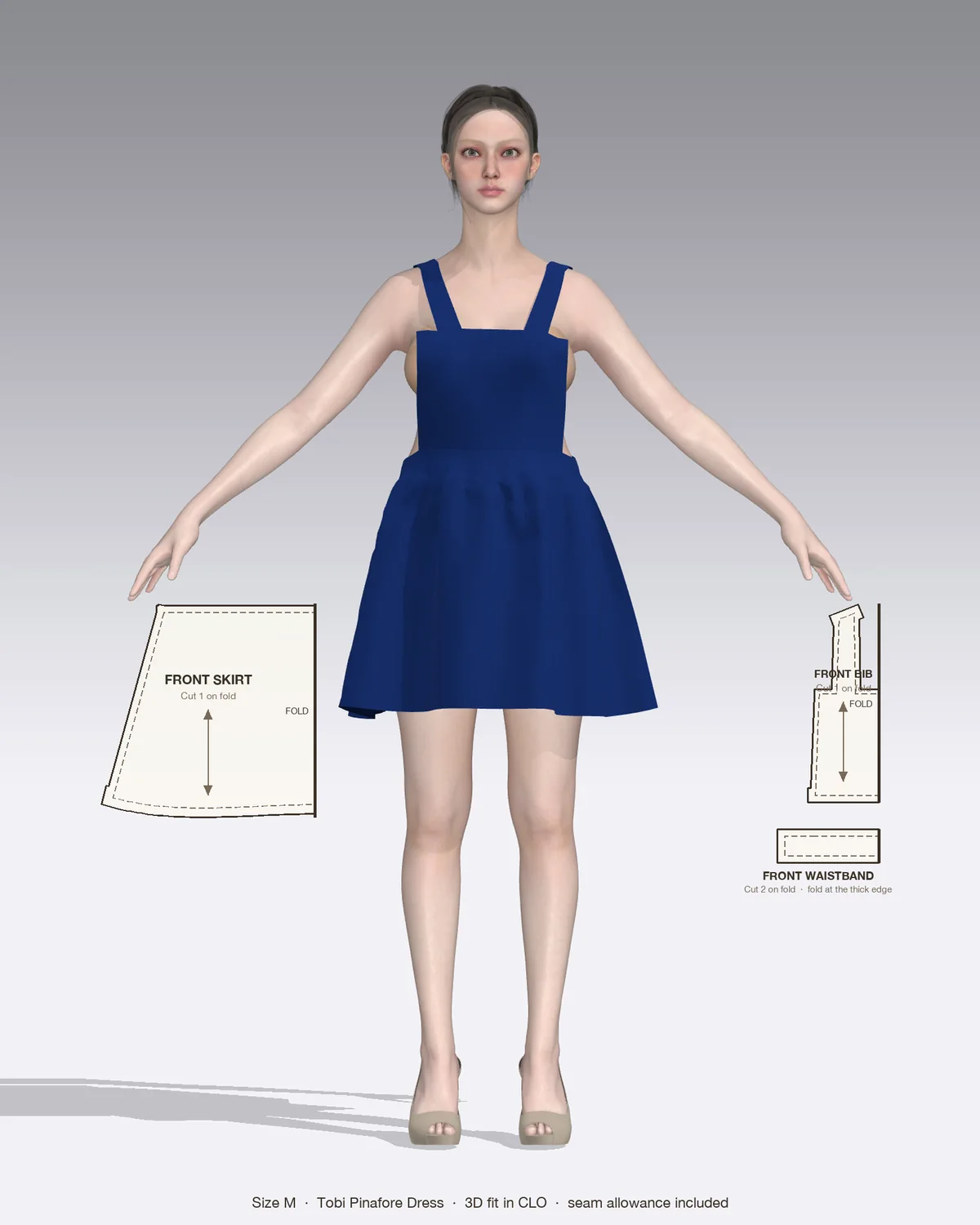
Draped in CLO 3D: the Tobi with its pattern pieces, drawn to scale.
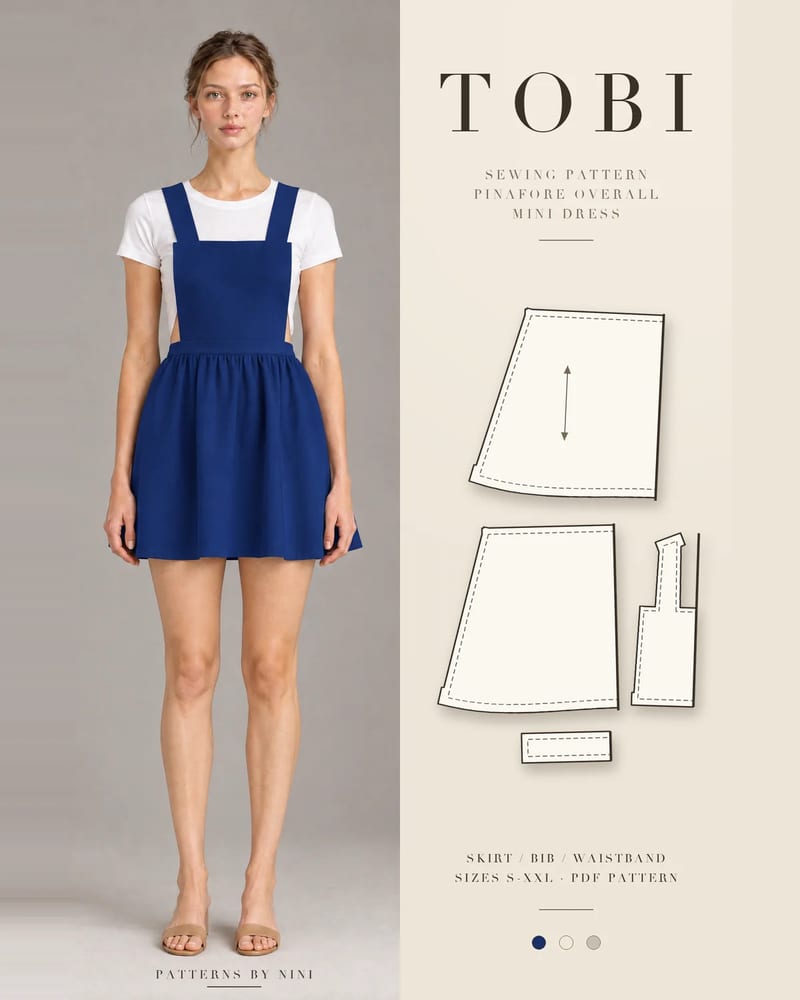
It’s the same skirt construction as the Tobi pinafore dress, whose full gathered mini skirt hangs from a 1 1/2 in (4 cm) interfaced waistband with an 8 in (20 cm) invisible zipper at the left side. Once you can sew this skirt, you can sew the bottom half of most dresses.
Choose your skirt style
Skirts come in a few basic shapes, and the shape decides how hard the project is:
Gathered (rectangle) skirt. Straight panels gathered into a waistband. No curves to fit, so it suits a first project.
Elastic-waist skirt. Rectangles with a casing at the top and elastic threaded through. No zipper, the quickest of all.
A-line skirt. Shaped side seams that flare from the waist, often with darts. Needs a pattern.
Pencil skirt. Close-fitting, with darts and a back slit or vent. Fitting takes more work.
Circle skirt. Cut from a circle with a calculated waist curve. Easy to sew, but the bias hem needs care.
What you need
Fabric. A mid-weight woven with some body: cotton twill, denim, corduroy, canvas, linen or quilting cotton. Tobi lists cotton twill, denim, corduroy, canvas or linen. Avoid slippery or stretchy fabric for a first skirt.
An invisible zipper, 7 to 9 in (18 to 23 cm) long, and an invisible zipper foot if you have one.
Matching thread, pins or clips, a tape measure, chalk, sharp scissors, a seam ripper and an iron.
Measure and cut
Measure your waist where the skirt will sit, and your full hip. For a gathered skirt the waist measurement matters most, since the gathers give plenty of room over the hips.
Decide the finished length. Measure from your waist down to where you want the hem.
Work out the skirt panels. The total width should be two to three times your waist: two times for a soft gather, three for a very full skirt. Split that into a front and back panel. Each panel’s length is the finished length plus the hem allowance plus the seam allowance at the top.
Work out the waistband. Cut length = your waist + 1 in (2.5 cm) ease + two seam allowances. Cut width = twice the finished width + two seam allowances. For a 1 1/2 in finished band with 5/8 in (1.5 cm) seam allowances, cut it 4 1/4 in (10.8 cm) wide.
Prewash and press the fabric the way you’ll wash the finished skirt.
Cut on grain. Keep the panel length parallel to the selvage so the skirt hangs straight. If you’re using a pattern, follow its pieces and size chart instead of these numbers.
Fuse the interfacing to the wrong side of the outer half of the waistband, using a press cloth and the time and heat on the interfacing’s instructions.
How to sew a skirt step by step
Use a 2.5 mm straight stitch and the seam allowance your pattern gives, often 5/8 in (1.5 cm). Press each seam before crossing it with another.
1. Sew the side seams
Pin the front and back panels right sides together at both side seams.
Sew the right side seam from top to hem.
On the left side, leave the top open for the zipper: measure the zipper’s teeth length down from the top seam line and mark it. Sew from that mark to the hem only.
Finish all raw edges with a zigzag or serger and press the seams open.
2. Gather the top edge
Set your machine to its longest stitch, usually 4 to 5 mm, and loosen the top tension slightly.
Sew two or three rows of gathering stitches inside the seam allowance, for example at 1/4 in (6 mm), 1/2 in (1.3 cm) and 3/4 in (2 cm) from the raw edge. Leave long thread tails and don’t backstitch.
Gather the front and back separately, so a snapped thread only affects one section.
Mark the center front, center back and side seams on both the skirt and the waistband, so you can match them.
3. Attach the waistband
Pin the interfaced half of the waistband to the skirt, right sides together, matching the marks. The waistband ends sit at the zipper opening.
Pull the bobbin threads to gather the skirt until it fits the band. Spread the gathers evenly between the pins.
Sew at the seam allowance with the gathered side facing up, so you can keep the folds from catching or pleating under the needle.
Press the seam allowance up into the waistband and remove any gathering stitches that show below the seam.
4. Sew the invisible zipper
Unzip the zipper and press the coils flat with a cool iron.
Pin one side of the zipper to the left side opening, face down on the right side of the fabric, with the top stop about 1/8 in (3 mm) below the waistband’s center fold line, which will become the top edge.
Sew close to the coil from the top down to the opening mark. Repeat for the other side, matching the waistband seam on both sides.
Close the zipper and check that it lies flat and the waistband seams line up.
The guide on how to sew an invisible zipper covers this step in more detail, including how to close the seam below it neatly.
5. Finish the waistband
Fold the waistband in half along its length, right sides together, so the ends wrap around the zipper tape. Stitch across each end and trim the corners.
Turn the band right side out and press. Press under the seam allowance on the inner edge.
Pin the inner edge so it just covers the waistband seam, then slip stitch it by hand or stitch in the ditch from the right side to catch it.
6. Hem the skirt
Try the skirt on and check the length in a mirror. Press up a double-fold hem, such as 1/4 in (6 mm) then 1/4 in again for a light fabric, or 1/2 in (1.3 cm) then 1 in (2.5 cm) for a heavier one, and topstitch or blind stitch it. The guide on how to hem a dress covers machine and hand hems, and works the same way for skirts. Give the skirt a final press.
Common mistakes and how to fix them
Mistake
What happens
Fix
Gathering in one long run
Threads snap and the fullness bunches
Gather front and back separately
Gathers bunched in one spot
Lumpy waist and uneven hang
Match the marks and spread the gathers before sewing
Waistband cut to your exact waist
Too tight to sit or breathe
Add 1 in (2.5 cm) ease
No interfacing in the band
The waistband rolls and creases
Fuse interfacing to the outer half
Zipper set below the band seam
A gap at the top of the opening
Place the top stop just under the waistband fold
Hemming before trying on
Uneven or wrong length
Try on and mark the hem first
Skirts to sew next
Every step above is part of the Tobi pinafore dress: a full gathered mini skirt, a 1 1/2 in (4 cm) interfaced waistband and an invisible zipper in the left side seam, with faced bibs and wide straps above, in sizes S to XXL.
For more practice with gathered skirts, the Chioma midi dress has a skirt gathered all round at the natural waist, and the Morayo skater dress has a full gathered knee-length skirt. To try a shaped skirt with no gathers, the Evie A-line dress has a smooth flared A-line skirt. Ready to add a bodice? The guide on how to sew a dress takes you from skirt to whole garment.
Frequently asked questions
What is the easiest skirt to sew for a beginner?
A gathered rectangle skirt with an elastic casing is the easiest: two straight panels, two side seams, a casing and a hem, with no zipper and no pattern pieces to fit. Once you've made one, try a gathered skirt on a flat waistband with an invisible zipper. That adds the two skills most skirts and dresses use.
How much fabric do I need to make a skirt?
For a gathered skirt, you need a total width of two to three times your waist and a length of your finished length plus hem and seam allowances. With 55 to 60 in (140 to 150 cm) wide fabric, a knee-length skirt for a 30 in (76 cm) waist usually fits in two panel lengths plus a waistband strip, about 1 1/2 yd (1.4 m).
Should a skirt zipper go in the side or the back?
Either works. A side zipper, usually on the left, keeps the center back smooth and hides well in the gathers. A center-back zipper is easier to reach on a fitted skirt and is what many dress patterns use. Use the position your pattern gives, because the waistband ends and notches are drafted around it.
Can I sew a skirt without a pattern?
Yes. Gathered rectangle skirts and elastic-waist skirts need only your waist, hip and length measurements, since the pieces are straight. Shaped skirts such as A-line, pencil and circle skirts need curved side seams, darts or a calculated waist curve, so a pattern saves a lot of trial and error for those styles.
A seam gauge for sewing is a 6 in ruler with a sliding marker. Learn to use it for even hems, seam allowances, buttonholes, pleats, darts and elastic casings.
How to sew T-shirts on a regular sewing machine: choose a knit, cut it, sew the shoulders, neckband, sleeves, side seams and hems, and fix wavy seams.
Help us understand what inspires you
May we use Pinterest cookies to measure visits and purchases and improve our advertising? You can shop either way and change your choice in Cookie settings. Privacy policy
 Patterns